1) The K Sound Group
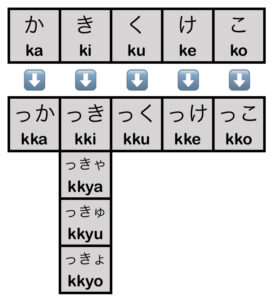
For these 8 situations, the soku-on simply tells you to make a glottal stop. The same characters with a soku-on and without a soku-on will make completely different words. Here are some examples:
みか is a woman’s name
but
みっか means “three days” or “the third day of a month”.
ゆっくり means “at your own pace”
but
ゆくり is not a word.
2) The S Sound Group
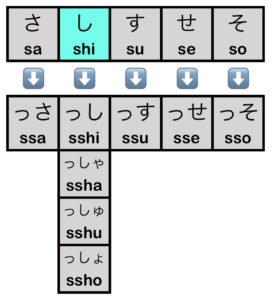
These 8 situations are pronounced a little differently. They are made not with a glottal stop, but by elongating the “s” sound.
いっしょ means “together”
but
いしょ means “a will” or “a note left by someone who has died”
The name of this blog is いっしょにほんご when you write it in Hiragana.
3) The T Sound Group
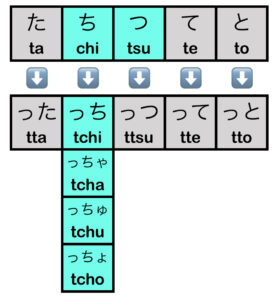
These 8 characters with a soku-on are pronounced with a glottal stop.
The super popular digital Tamagotchi pets are an example of using そくおん. You would spell it as たまごっち in Hiragana.
くっつく means “to stick together”
but
くつく is not a word.
4) The P Sound Group
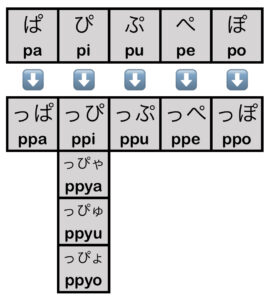
Finally we have words with the regular P Sound Group:
いっぱい = one cup / bowl of something
しっぱい = failure, mistake, blunder
しゅっぱつ = departure, leaving
やっぱり = as expected, it makes sense (that)
りっぱ = splendidness, being fine, handsomeness
いっぽう = one way (out of two)
いっぽん = one long cylindrical thing
にっぽん = a more formal way of saying Japan
An Ending っ
Sometimes you will see small つ at the end of a word or a sentence. This is just a way for the speaker or writer to express emotions (usually anger, surprise, or sadness). You may see small つ used together with long vowel sounds like below:
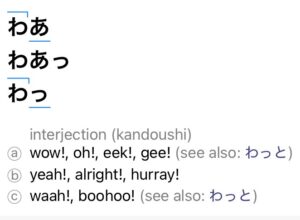
Just keep in mind that these are all basically pronounced the same so the difference is mainly when reading them. Because you have the ability to use / mix and match long vowel sounds, ちょうおんぷ and the small つ, it gives you a lot more flexibility to express emotions through text.
The Character Before っ
Let’s take a look at the word がっこう. It means “school”. We’ve been focusing on the small つ and the character after it.
っこ ➡️ kko
But now I’d like to focus on the small つ and the character before it.
がっ
We will deep-dive into this in the Kanji section, but it turns out that many times, the small つ actually means that there was a sound change!
For がっこう, there is actually a “hidden character” (く) under the small つ!Crazy stuff!

Just for your own curiosity, when you learn new words with the small つ, look them up in a dictionary and see how many times there is a hidden character under the small つ. It’s not 100% of the time, but you might be surprised at how often it happens.