Small や、ゆ、and よ (Yō-on)
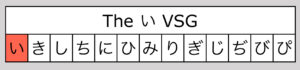
To write our final set of characters first we will need 12 out of 13 characters from the い VSG. For a review of what a VSG is, take a look here. We won’t need the い character.
Next we need the miniature versions of the Y Sound Group. Here they are with the regular versions side-by-side for comparison:
やゆよ and ゃゅょ
On the keyboard if you want to type the small versions, you type the letter “x” followed by one of the three characters. (Type “xya” to get ゃ, etc.) *
The ゃ Sound Group
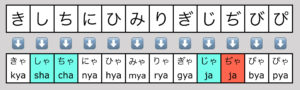
Notice that we took 12 characters from the い VSG and attached a small や character to each of them. Most of the time you are replacing the “i” sound with a “ya” sound. The exceptions are しゃ, ちゃ, and じゃ (where the “i” sound is replaced by an “a” sound only).
I colored ぢゃ in red because you will probably never see it out in the wild, but I added it here for completeness. (And because 12 is a much nicer number than 11, innit?)
The ゅ Sound Group
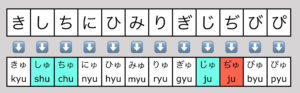
Likewise, this group combines the same 12 characters of the い VSG with the small ゆ character. In the case of しゅ, ちゅ, and じゅ only an “u” sound is added. Again, if you ever hear a “ju” sound, it will almost always be じゅ instead of ぢゅ.
The ょ Sound Group
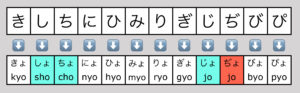
Finally we can add a small よ character to the same 12 characters to get the よ sound group. Just like with ぢゃ and ぢゅ, if you hear the sound “jo” it will almost always be represented by じょ instead of ぢょ.
The “NY” Problem
Now, as a native New Yorker, I have to say that this section is not about a problem with New York! This is actually a problem with writing words in Romaji. Look at these 4 Japanese words:
konya, honyaku, onyomi, kunyomi
Let’s take those first 2 words, konya and honyaku. konya means “this evening” or “tonight”. Honyaku means “the Japanese translation of a word.” The problem though, is that “nya” combination of letters. If we were to write those words in Hiragana, should we use “にゃ” or “んや”??
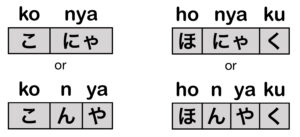
In order to get around this problem, we need to use an apostrophe to indicate whether you need 1 or 2 Hiragana characters. If there is an apostrophe after the “n”, it means you need the ん character. If there is no apostrophe, you will have either the にゃ、にゅ or にょ characters.**
Of course, as your Japanese improves, you’ll see those words written in Kanji. Through studying Kanji, you’ll get a much better sense of how Japanese words are separated.
Conclusion
So there you have it! Coincidentally, if you care about formal names, these 36 characters are called ようおん.
Now you’re one step closer to mastering Hiragana! There’s no shortage of reading and writing practice for Hiragana out there. Have fun and take pride in the fact that you’ve made it this far.
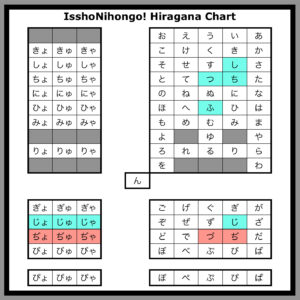
Next post we’ll look at long vowel sounds. Until then I’ll leave you with the full version of my handy Hiragana chart! Practice until you know every character without needing Romaji. Good luck!