1) The “M” Sound [m]
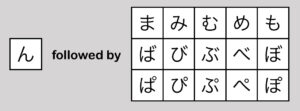
The sound combination of “n” with any of those other sounds is actually inconvenient for your mouth to produce. Of course it is possible, but in order for an easier pronunciation and to save time, your mouth basically changes the “n” sound to get ready for the next sound. This results in the sound becoming the “m” sound. Let’s look at an example:
あんまり means “not much” or “not really”.
If you pronounced each sound for a small child to repeat, you would say “a-n-ma-ri”.
When you say this word in a sentence though, it’s pronounced as “am-mari”.
Here is another example with a famous train station in Tōkyō – しんばし:
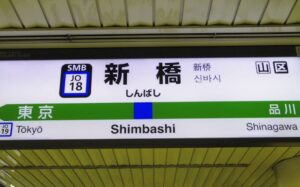
See how the ん is written as an “m” in the romaji spelling?
Here are some more examples:
こんばんは = good evening (pronounced as kom-ban-wa)*
じゅんび = preparation (pronounced as jum-bi)
ぜんぶ = all, everything (pronounced as zem-bu)

えんぴつ = pencil (pronounced as em-pitsu)
さんぽ = a walk, a stroll (pronounced as sam-po)
2) The “NG” Sound [ŋ]
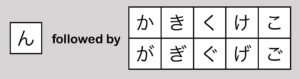
Our next pronunciation of ん is as the “NG” sound, like in the English word “sing”. If you focus on how you say the words “sink” and “sing” you’ll notice that these words both have the “ng” sound.
Some Japanese examples are:
げんかん = entrance or entryway (pronounced as “geng-kan”)
げんき = lively, energetic (pronounced as “geng-ki”)
てんき = the weather, good weather (pronounced as “teng-ki”)
でんき = electricity (pronounced as “deng-ki”)
べんきょう = study (pronounced as “beng-kyō”)
ゆうびんきょく = post office (pronounced as “yū-bing-kyoku”)
ぎんこう = a bank (pronounced as “ging-kō”)
おんがく = music (pronounced as “ong-gaku”)
こんげつ = this month (pronounced as “kong-getsu“)
ばんごう = (pronounced as “bang-gō“)
3) The Nasalized Vowel Sound [Ṽ]
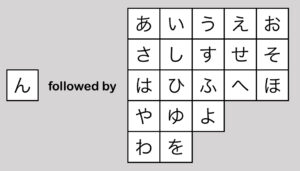
This pronunciation of ん is a bit tricky. When it comes before any of those characters, it is basically pronounced as a more nasalized version of the “n” sound. Try humming the “n” sound from your nose and you will get this version of ん.
Now, take a look at the next 3 words:
げんいん
げにん (be careful!)
げいいん (ambiguous)
げんいん means “cause” or “original source”. It’s very important that you pronounce the ん separately from the い. If you pronounce it as “ge-nin” (げにん) you are saying “a low-rank person” or “a peasant”! If you pronounce it as “gei-in” (げいいん) the meaning becomes “over drinking”!
“Over drinking” is ONLY pronounced as げいいん. Interestingly though, because the pronunciation of げんいん and げいいん are so close, BOTH have become associated with the “cause” meaning. This leads to even native speakers getting confused sometimes!
Here are 2 more words where the first pronunciation has evolved into 2 choices for the same meaning:
ふんいき (now ふいんき is also possible) = vibe or atmosphere
はんおう (now はんのう is also possible) = response, replying
The next set of words are all pronounced with the nasalized vowel sound:
あんしん = peace of mind, relief
ぜんしん = whole body
でんしゃ = a train
こんしゅう = this week
ぶんしょう = sentences
せんせい = teacher, doctor, master
じんせい = one’s life
せんそう = war

きんようび = Friday

でんわ = telephone, or a telephone call ほん を = a book, or books (as the direct object of an action)

