The G Sound Group (K→G)
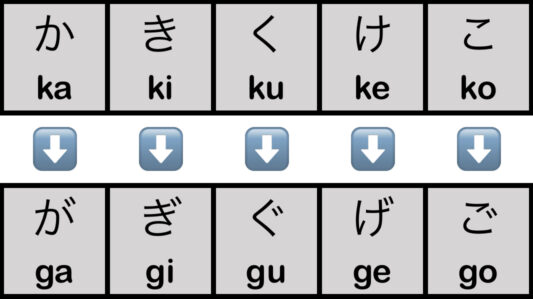
These sounds are completely regular. Just combine the “g” sound with the 5 Japanese vowel sounds – あ、い、う、え、and お.
The Z Sound Group (S→Z)
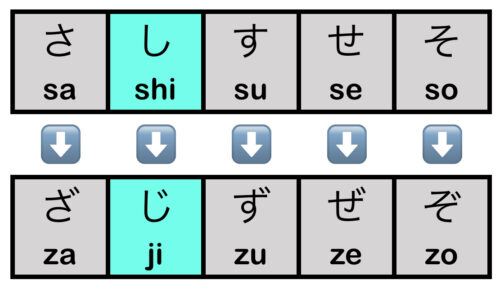
For these 5 sounds, there is only one irregular pronunciation. Instead of “zhi” or “zi” you pronounce じ as “ji” (just like the name of our letter G). Other than that, you just combine the “z” sound with the あ、う、え、and お sounds.
The D Sound Group (T→D)
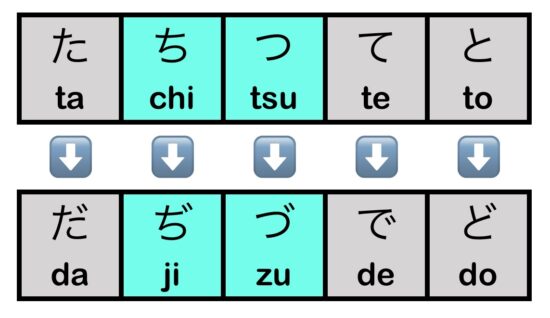
In this group there are 2 exceptions! ぢ is pronounced as “ji” and づ is pronounced as “zu”. At this point, you might be wondering why BOTH じ and ぢ are pronounced as “ji”. In the past these two characters were pronounced differently, but as the language evolved, the two pronunciations converged into one. I would say about 95% of the time, if you hear the “ji” sound, it will be the じ character.*
Next, let’s talk about the difference between ず and づ. These characters actually do have different pronunciations, but the difference is very very small. (づ has a hint of a “z” sound in the middle whereas ず doesn’t.) There have been times when I hear a “zu” sound and I’m not sure if it’s ず or づ. The good news is that a majority of times it ended up being ず. In these cases, it’s actually better for you to make a mistake and get corrected because you will likely remember it more.
The B Sound Group (H→B)
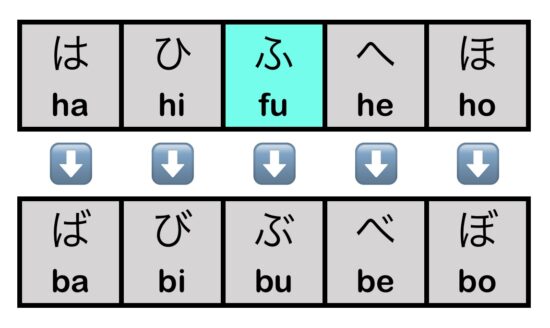
Good news! This group is completely regular. These characters go from an “h” sound to a “b” sound. Even ふ changes to a “b” sound, so it will be easy to remember.
The P Sound Group (H→P)
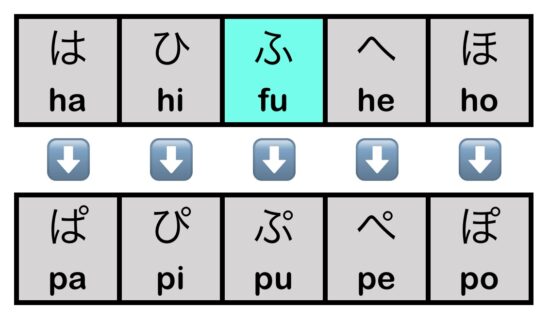
Our last group uses small circles instead of a quotation marks. These characters go from an “h” sound to a “p” sound. The character ふ again loses its irregular pronunciation, so it will be easy to remember.
Sorting the Characters
Lastly, we should talk about character order. How would you look up these characters in a dictionary or on a website? There are 3 different ways that you might find them sorted.
The first possibility is that these 25 characters will be separated from the basic 46 Hiragana characters. That is what I’ve done here. However, this is very rare. For Japanese-learners, this is a useful way to sort the characters, but you won’t really find this grouping out in the wild very often.
Most of the time, these characters will not be separated on their own. That is to say, they will be grouped together with their regular Hiragana counterparts. (か and が will be together, as will き and ぎ and so on.) The question is, will the dakuten and han-dakuten characters appear after or mixed together with the regular characters?
In the following picture, there is no separation. Several areas of Tōkyō are listed. An area called ぎんざ (銀座) is listed in the か row. There is no separate が row. Notice that it comes before an area called きば (木場).
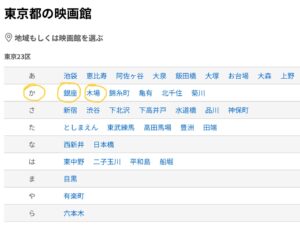
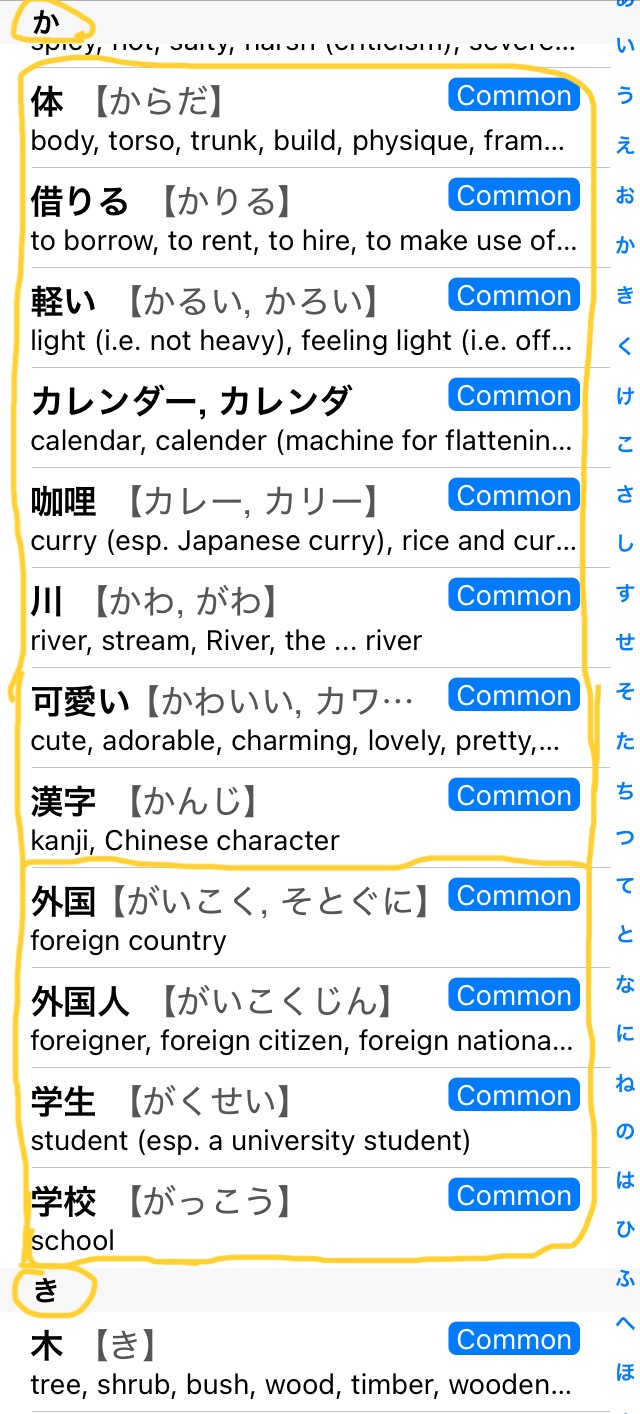
On the other hand, the main dictionary that I use sorts words in a slightly different way. This time, there is a kind of separation.
The か section still contains words that start with が、but they appear at the end. THEN it moves on to the き section. Here is a picture: